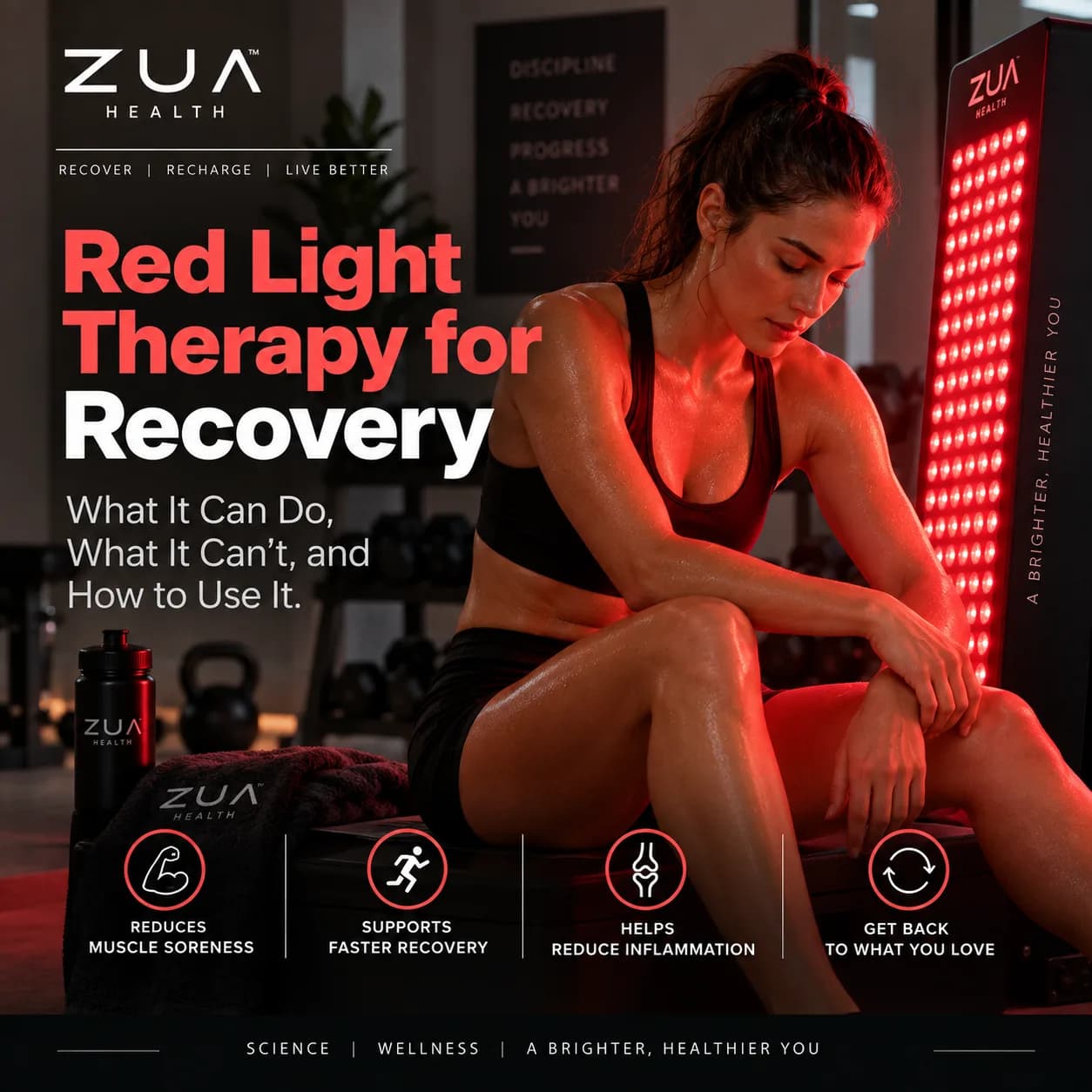
Red Light Therapy for Recovery: What It Can Do, What It Can't, and How to Use It
Recovery has become just as important as training for athletes, gym-goers and active people. Whether you're lifting weights, running, cycling, playing sport or simply dealing with physically demanding work, how well you recover can have a major impact on how you feel and perform.
That's one reason red light therapy for recovery has become increasingly popular.
Red and near-infrared light therapy, also known as photobiomodulation (PBM), is being investigated for its potential role in muscle recovery, soreness, exercise performance and tissue support. Research has produced some promising results, but it is also important to understand where the evidence is still developing.
Red light therapy isn't a replacement for sleep, nutrition, hydration, sensible training or appropriate medical care. Instead, it may be considered as one additional tool within a broader recovery routine.
In this guide, we'll look at what red light therapy can realistically do for recovery, what it can't do, how it may fit around exercise, what to look for in a device and how to use it responsibly.
Important: Red light therapy should not be used as a substitute for medical diagnosis or treatment. If you have persistent pain, an unexplained injury or another ongoing health concern, speak with an appropriately qualified healthcare professional.
What Is Red Light Therapy?
Red light therapy uses specific wavelengths of non-UV light to expose the body to controlled light.
You'll often see it referred to as photobiomodulation, LED light therapy, low-level light therapy or low-level laser therapy.
Red light is visible to the human eye, while near-infrared light is outside the visible spectrum. Both types can be used in photobiomodulation, although they have different properties and may interact with tissue at different depths.
This is particularly relevant when talking about recovery.
A device designed primarily for facial skin isn't necessarily the same as a device designed to expose larger muscle groups. Treatment area, wavelength, output and treatment distance all influence how a device should be used.
For a broader overview of red light therapy, including its potential benefits, common uses, safety and what to consider when choosing a device, read our Red Light Therapy Australia guide.
Why Are People Using Red Light Therapy for Recovery?
After exercise, the body goes through a range of normal processes associated with physical stress, muscle fatigue and recovery.
Depending on the type and intensity of exercise, you may experience:
Why Are People Using Red Light Therapy for Recovery?
After exercise, the body goes through a range of normal processes associated with physical stress, muscle fatigue and recovery.
Depending on the type and intensity of exercise, you may experience:
- Muscle soreness
- Temporary fatigue
- Reduced muscle performance
- Stiffness
- General physical discomfort
- The need for additional recovery time
Photobiomodulation has attracted attention because researchers have investigated whether specific light exposure can influence some of the biological processes associated with exercise recovery.
The important word here is support.
Red light therapy shouldn't be viewed as a way to erase the effects of hard training instantly. Instead, research is exploring whether it can help support certain aspects of recovery when used with an appropriate protocol.
Does Red Light Therapy Actually Help Muscle Recovery?
There is promising research, but the answer isn't as simple as saying that red light therapy will always make you recover faster.
If you're wondering whether red light therapy actually works, our guide Does Red Light Therapy Actually Work? What the Science Says in Australia explains what the current evidence says about its potential benefits, recovery, safety and what to realistically expect.
A 2025 systematic review and meta-analysis examining photobiomodulation among other recovery methods found low-certainty evidence that PBM applied before exercise could reduce muscle soreness and improve muscle performance at 24 hours after exercise-induced muscle damage.
Another 2025 systematic review focusing specifically on delayed onset muscle soreness found that photomodulation was associated with reductions in soreness at later follow-up points and improvements in muscle strength at 24 and 48 hours in the studies included in the analysis.
These findings are encouraging, but the research also highlights an important limitation: different studies use different wavelengths, doses, treatment areas and protocols.
That makes it difficult to say there is one universal red light therapy routine that works for everyone.
So the more accurate conclusion is that photobiomodulation may have a useful role in certain aspects of exercise recovery, but results can vary depending on how the treatment is delivered.
Red Light Therapy and Delayed Onset Muscle Soreness
Delayed onset muscle soreness, commonly called DOMS, is the soreness and stiffness that can develop after unfamiliar or particularly demanding exercise.
It can be especially noticeable after:
- Heavy resistance training
- Leg workouts
- Running
- Downhill running
- High-intensity interval training
- New exercises
- Returning to training after a break
DOMS can make everyday movement uncomfortable and may temporarily affect how you train.
Research into photobiomodulation has investigated whether red and near-infrared light can help reduce this type of soreness and support the return of muscle function.
A 2025 systematic review and meta-analysis found potentially meaningful improvements in delayed onset muscle soreness and muscle strength at specific follow-up periods, although the researchers also noted that more research is needed to establish optimal treatment protocols.
That distinction matters.
Red light therapy may be a useful recovery tool, but it shouldn't be promoted as a guaranteed way to eliminate DOMS.
Can Red Light Therapy Improve Exercise Performance?
This is where the answer becomes more complicated.
Some studies have investigated photobiomodulation before exercise as a potential way to influence muscle endurance, strength or performance.
Some research has reported positive effects, while other studies have found little or no meaningful improvement.
For example, a meta-analysis examining running performance found no significant overall improvement in time-trial or time-to-exhaustion performance from photobiomodulation.
Other research has reported improvements in certain measures of muscle endurance and strength recovery.
The takeaway is simple:
Red light therapy should not be treated as a guaranteed performance enhancer.
If it provides a benefit for a particular person or protocol, that benefit is likely to depend on factors such as the treatment dose, wavelength, timing and type of exercise.
Your training program, sleep and nutrition remain much more fundamental to performance.
What About Whole-Body Red Light Therapy?
Whole-body red light therapy has become increasingly popular because it allows larger areas of the body to be exposed during one session.
This can be appealing to people who want recovery support across multiple muscle groups rather than targeting one specific area.
However, bigger coverage doesn't automatically mean better results.
A 2025 systematic review examining whole-body photobiomodulation for exercise performance and recovery identified only five eligible studies involving 105 physically active participants. Some studies reported improvements in subjective sleep quality, but the review did not find evidence of improved exercise performance or physiological markers of fatigue.
That means whole-body photobiomodulation is an interesting and developing area of research, but the evidence isn't strong enough to claim that full-body treatment automatically improves athletic performance.
For someone considering a full-body system, the main practical advantages may include coverage, convenience and the ability to incorporate treatment into a regular routine.
ZUA Health offers full-body red light therapy systems designed for broader treatment areas, including the Z7 Red Light Bed and Z6N Plus Red Light Bed.
Red Light Therapy Before or After Exercise?
One of the most common questions is whether red light therapy should be used before or after a workout.
There isn't one universal answer.
Research has investigated both pre-exercise and post-exercise applications, and the appropriate approach can depend on the intended goal and the device being used.
Using Red Light Therapy Before Exercise
Some research has investigated photobiomodulation before exercise, particularly in relation to muscle performance and subsequent recovery.
The potential reasoning is that light exposure may influence biological processes before the muscle is subjected to exercise stress.
However, this doesn't mean that everyone should automatically use red light therapy immediately before every workout.
Follow the protocol provided with your specific device.
Using Red Light Therapy After Exercise
Post-exercise use is popular among people who want to incorporate light therapy into their recovery routine.
The goal may be to support muscle comfort and recovery after demanding activity.
Again, treatment timing should be based on the device's intended use rather than simply choosing the longest possible session.
If you're unsure whether pre- or post-workout treatment is appropriate for your specific device, follow the manufacturer's instructions or speak with an appropriately qualified professional.
How Does Red Light Therapy Work for Recovery?
Photobiomodulation research has explored how red and near-infrared light may influence cellular activity.
One area of interest is the mitochondria, which play an important role in cellular energy production.
Researchers have proposed several possible mechanisms through which photobiomodulation may influence cellular signalling, energy metabolism and responses associated with tissue stress.
However, it's important not to confuse a proposed mechanism with a guaranteed outcome.
Understanding how a treatment might work biologically is different from proving that a particular consumer device will produce a specific result.
That is why high-quality research and appropriate treatment protocols matter.
What Red Light Therapy Can Do for Recovery
Based on current research, there are several areas where red light therapy may be worth investigating as part of a recovery routine.
1. Support Muscle Recovery
Photobiomodulation has been investigated for its potential effects on muscle recovery following exercise.
Some studies have reported improvements in measures such as muscle soreness and recovery of muscle function.
2. Help With Exercise-Related Soreness
Research into DOMS suggests that photobiomodulation may reduce soreness at certain time points following demanding exercise.
This could be particularly relevant for people who regularly experience significant soreness after unfamiliar or high-intensity training.
3. Support Muscle Function
Some research has investigated whether PBM can help restore muscle strength following exercise-induced muscle damage.
Results vary between studies, but this remains an active area of research.
4. Fit Into a Broader Recovery Routine
One of the biggest practical advantages of red light therapy is that it can be incorporated into an existing recovery routine.
It can sit alongside:
- Quality sleep
- Good nutrition
- Hydration
- Appropriate rest
- Mobility work
- Stretching where appropriate
- Structured training
- Professional treatment when required
That is a much more realistic way to think about recovery than looking for one technology to do everything.
What Red Light Therapy Can't Do
This part is just as important as understanding the potential benefits.
It Can't Replace Sleep
If you're consistently sleeping poorly, adding red light therapy to your routine isn't going to compensate for inadequate recovery.
Sleep remains one of the most important foundations of physical and mental recovery.
It Can't Replace Good Nutrition
Your body needs adequate energy, protein, carbohydrates, fats, vitamins and minerals to support training and recovery.
Light therapy isn't a substitute for a balanced diet.
It Can't Fix Every Injury
Persistent pain or an injury can have many different causes.
Red light therapy shouldn't be used as a reason to ignore an injury or avoid professional assessment.
It Can't Guarantee Better Athletic Performance
Although some studies have reported positive performance-related outcomes, other research has found no meaningful improvement.
Therefore, it would be misleading to describe red light therapy as a guaranteed performance enhancer.
It Can't Make Overtraining Disappear
If you're consistently training beyond your ability to recover, adding another recovery tool doesn't necessarily solve the underlying problem.
Training volume, intensity, rest and programming still matter.
How to Use Red Light Therapy for Recovery
The correct treatment protocol depends on the device you're using.
There is no single session length or frequency that applies to every red light therapy system.
Before using a device, check:
- Wavelength specifications
- Irradiance information
- Recommended treatment distance
- Recommended session duration
- Recommended treatment frequency
- Safety instructions
- Eye protection requirements
Don't assume that a longer session will produce better results.
Photobiomodulation has a dose-response relationship, meaning the amount of light delivered matters. More exposure isn't automatically better.
How Long Should You Use Red Light Therapy for Recovery?
There is no universal treatment duration.
The appropriate session length depends on the device's output, wavelength, treatment distance, coverage area and intended use.
For example, a small targeted device may be designed around a different treatment protocol from a large full-body red light therapy system.
This is why copying someone else's routine from social media can be misleading.
Use the treatment instructions supplied with your specific device.
How Often Should You Use Red Light Therapy?
Frequency also depends on the device and its intended application.
Some products are designed for regular use, while others may have different recommended schedules.
Consistency is generally more sensible than excessive exposure.
If you're using red light therapy around exercise, keep track of how you feel and how your training is progressing rather than automatically increasing treatment time.
If you experience persistent irritation, unusual discomfort or another unexpected reaction, stop using the device and seek appropriate advice.
Red Light Therapy for Different Types of Training
Strength Training
People who perform resistance training may be interested in red light therapy because heavy workouts can produce temporary muscle soreness and fatigue.
Photobiomodulation research has investigated muscle strength recovery and soreness following exercise-induced muscle damage.
It may therefore be an interesting addition to a strength-training recovery routine, particularly when used alongside adequate rest and nutrition.
Running
Running creates a different recovery challenge because of repeated impact and the specific demands placed on the lower body.
Research into photobiomodulation and running performance has produced mixed results, so red light therapy shouldn't be treated as a guaranteed way to improve running times.
For runners, the fundamentals still come first: training structure, recovery days, footwear, nutrition and sleep.
Cycling
Cyclists may use red and near-infrared light as part of a broader lower-body recovery routine.
As with other sports, the potential benefit depends on the treatment protocol and individual response.
Team Sports
Football, soccer, basketball, tennis and other sports can combine high-intensity bursts with repeated training sessions.
For athletes training frequently, recovery becomes an important part of maintaining performance.
Red light therapy may be considered one component of that routine, but it shouldn't replace proper conditioning and recovery planning.
Red Light Therapy for Muscle Soreness vs Injury
It's important to distinguish ordinary post-exercise soreness from an actual injury.
Normal exercise-related soreness may develop after a challenging or unfamiliar workout and generally improves over time.
An injury may involve symptoms such as:
- Persistent or worsening pain
- Significant swelling
- Loss of movement
- Sudden weakness
- Instability
- Severe bruising
- Pain that doesn't improve
If you're dealing with a suspected injury, don't rely on red light therapy alone.
Getting an appropriate assessment can help determine what is actually causing the problem and what treatment is suitable.
Red Light Therapy and Inflammation
Inflammation is another reason red light therapy is often discussed in the recovery space.
Photobiomodulation research has explored its potential influence on inflammatory signalling and tissue responses.
However, inflammation is a normal and complex part of the body's response to exercise and injury.
It isn't accurate to assume that reducing every inflammatory response is automatically beneficial.
The goal should be appropriate recovery rather than trying to eliminate every normal response to training.
Red Light Therapy and Sleep
Sleep is one of the most important parts of recovery, which has led researchers to investigate whether whole-body photobiomodulation could influence sleep quality.
A 2025 systematic review of whole-body PBM found that some included studies reported better subjective sleep quality, although the overall evidence base was small and the review did not find improvements in exercise performance or physiological fatigue markers.
This means the relationship between red light therapy and sleep is interesting, but it shouldn't be presented as a proven sleep treatment.
If recovery is your goal, prioritise a consistent sleep routine before looking for additional technologies.
Choosing a Red Light Therapy Device for Recovery
If you're considering purchasing a red light therapy device specifically for recovery, there are several things worth checking.
Wavelengths
Look for clearly stated wavelength information rather than vague descriptions such as "advanced infrared technology."
Red and near-infrared wavelengths can have different penetration characteristics, so the wavelength profile should match the intended application.
Irradiance
Irradiance describes the optical power delivered over a specific area and is commonly expressed in mW/cm².
This is useful when comparing devices because two products can both be marketed as red light therapy systems while delivering very different amounts of light.
Treatment Coverage
Think about how you actually plan to use the device.
If you're mainly interested in one area, a targeted device may be sufficient.
If you want to treat larger areas after training, a panel, mat or full-body system may be more convenient.
ZUA Health's range includes targeted and full-body red light therapy equipment. You can explore the red light therapy collection to compare different formats.
Ease of Use
The best device isn't necessarily the one with the most impressive specifications.
If a device is difficult to position or inconvenient to use, you're less likely to maintain a consistent routine.
Consider where you'll use it, how much space you have and whether the treatment area suits your recovery goals.
Warranty and Support
Recovery equipment is an investment, particularly when you're purchasing a larger system.
Check warranty information, support options and the availability of genuine product documentation before purchasing.
Panel, Mat or Red Light Bed: Which Is Better for Recovery?
There isn't one option that is automatically best for everyone.
| Device Type | Best Suited To | Main Advantage |
|---|---|---|
| Red Light Panel | Targeted or flexible treatment | Versatile positioning |
| Red Light Mat | Convenient body coverage | Easy to incorporate into a routine |
| Red Light Bed | Large-area or full-body treatment | Broad coverage |
For someone who wants flexibility, a panel may be the most practical option.
For someone who prefers a convenient surface-based treatment, a red light therapy mat may be appealing.
For people interested in broad full-body exposure, a red light bed may provide the most convenient coverage.
The right choice depends on your goals, space, budget and preferred routine.
Why Recovery Is More Than Red Light Therapy
One of the biggest mistakes people make when exploring recovery technology is looking for one solution that can replace everything else.
Recovery is multi-factorial.
Your body needs:
- Enough sleep
- Appropriate nutrition
- Hydration
- Rest between demanding sessions
- Appropriate training progression
- Stress management
- Movement and mobility
- Professional support when needed
Red light therapy can potentially sit within that system, but it shouldn't be the foundation of it.
Think of it as an additional recovery tool rather than a shortcut.
Common Mistakes When Using Red Light Therapy for Recovery
Using Too Much Light
More exposure isn't automatically better.
Follow the manufacturer's recommended protocol rather than extending sessions because you want faster results.
Choosing a Device Based Only on Price
A cheaper device isn't necessarily better value, and an expensive device isn't automatically better either.
Compare specifications, coverage, construction, warranty and intended use.
Ignoring Treatment Distance
The distance between your body and the light source can influence the amount of light reaching the treatment area.
Follow the positioning instructions supplied with the device.
Expecting Immediate Results
Recovery isn't usually something you can measure from one session.
If you're using red light therapy consistently, give yourself enough time to assess whether it is making a meaningful difference.
Using It Instead of Proper Medical Care
Persistent pain, significant injuries or unexplained symptoms should be assessed appropriately.
Red light therapy shouldn't delay professional medical care.
Is Red Light Therapy Safe for Recovery?
Red light therapy is generally considered to have a favourable short-term safety profile when used correctly.
Unlike ultraviolet light, standard red and near-infrared therapy does not rely on UV radiation.
However, incorrect use can still cause unwanted effects.
Possible issues may include:
- Temporary redness
- Skin irritation
- Eye discomfort
- Headache in some situations
- Rash or irritation
Follow the manufacturer's safety instructions, particularly any recommendations relating to eye protection.
If you're taking medication that increases photosensitivity, have a significant eye condition or have another medical concern involving light exposure, speak with a healthcare professional before treatment.
How to Build Red Light Therapy Into a Recovery Routine
If you want to experiment with red light therapy as part of your recovery routine, keep the process simple.
Step 1: Identify Your Goal
Decide whether your priority is muscle soreness, general recovery, skin, relaxation or another specific goal.
Step 2: Choose an Appropriate Device
Select a device that provides the coverage and specifications appropriate for your intended use.
Step 3: Learn the Recommended Protocol
Read the manufacturer's instructions before your first session.
Pay attention to treatment distance, session length and recommended frequency.
Step 4: Stay Consistent
Don't judge the technology based on one session.
Use it consistently according to the recommended protocol and pay attention to how your body responds.
Step 5: Track Your Results
If you're using red light therapy specifically for exercise recovery, consider keeping a simple record of training, soreness and recovery.
This can help you decide whether the addition is actually useful for you.
Frequently Asked Questions
Does red light therapy help with muscle recovery?
Research suggests photobiomodulation may help with certain aspects of muscle recovery, including muscle soreness and recovery of strength after exercise-induced muscle damage. However, results vary and the evidence is not equally strong across every application.
Is red light therapy good after a workout?
Red light therapy is commonly used as part of post-workout recovery routines. Research has investigated both pre- and post-exercise applications, but the appropriate timing depends on the device and intended use.
Can red light therapy reduce muscle soreness?
Some research suggests photobiomodulation may reduce delayed onset muscle soreness at certain time points following exercise. However, it shouldn't be considered a guaranteed way to eliminate soreness.
Should I use red light therapy before or after exercise?
Both approaches have been studied. The best timing depends on your device, treatment goal and manufacturer's recommended protocol. Don't assume that one timing strategy works for every device.
Can red light therapy improve athletic performance?
Evidence is mixed. Some studies have reported improvements in specific performance or recovery measures, while other research has found no significant improvement. It should not be treated as a guaranteed performance enhancer.
How often should I use red light therapy for recovery?
There is no universal schedule. Frequency depends on the device, wavelength, output, treatment area and intended use. Follow the instructions supplied with your specific device.
How long should a red light therapy recovery session last?
Session duration varies between devices. Treatment time should be based on the manufacturer's instructions rather than a generic recommendation found online.
Can I use red light therapy every day after exercise?
Whether daily use is appropriate depends on the device and its recommended protocol. More exposure isn't automatically better, so follow the manufacturer's instructions.
Does red light therapy replace rest days?
No. Red light therapy should not be considered a replacement for adequate rest. Recovery requires a combination of sleep, nutrition, hydration, appropriate training and rest.
Is a red light bed better than a panel for recovery?
Not necessarily. A red light bed offers broad coverage and convenience, while a panel can provide more flexible positioning. The right choice depends on your recovery goals, available space and preferred routine.
Is red light therapy safe?
Red light therapy generally has a favourable short-term safety profile when used correctly. Follow the manufacturer's safety instructions and speak with a healthcare professional if you have a medical condition or concern that could affect your suitability for light therapy.
Final Thoughts
Red light therapy has become an increasingly popular addition to modern recovery routines, and there is legitimate scientific interest behind photobiomodulation.
Research suggests that it may help with certain aspects of exercise recovery, particularly muscle soreness and recovery of muscle function in some circumstances. However, the evidence remains mixed for broader claims involving athletic performance and whole-body recovery.
That is why the smartest approach is to keep expectations realistic.
Don't think of red light therapy as a replacement for sleep, nutrition, hydration, training structure or professional care.
Instead, think of it as one potential tool within a much bigger recovery strategy.
If you're considering red light therapy for recovery, start by identifying your goal, then choose a device with transparent specifications and follow its recommended treatment protocol.
Whether you choose a targeted panel, a red light therapy mat or a full-body system, consistency and appropriate use matter far more than simply choosing the biggest or most expensive device.
For more information about red light therapy, recovery equipment and wellness technology, explore the ZUA Health News & Recovery Guides.
Better recovery isn't about finding one magic solution. It's about building a routine that works together.