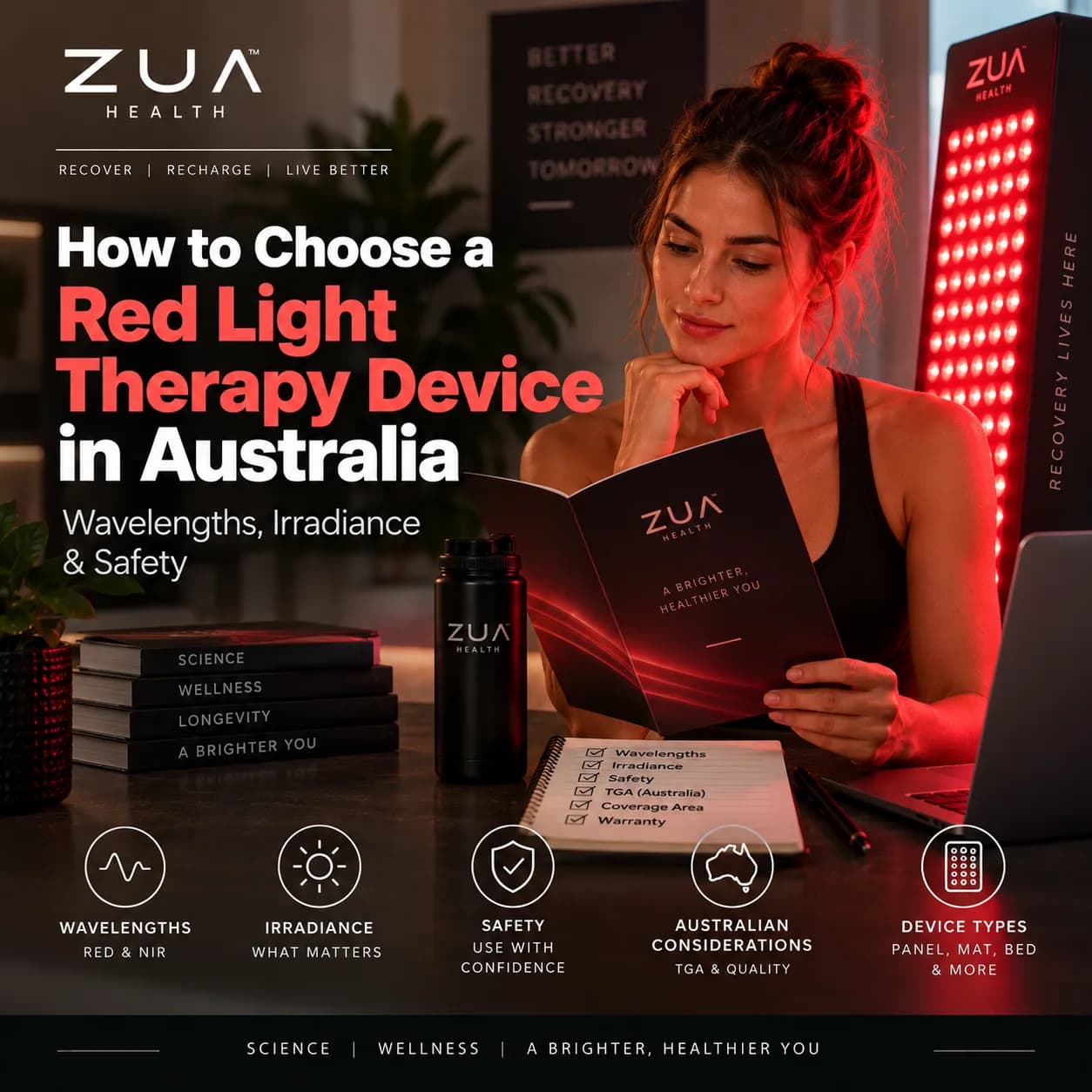
How to Choose a Red Light Therapy Device in Australia: Wavelengths, Irradiance & Safety
Choosing a red light therapy device can be surprisingly difficult.
Search online and you'll find everything from small handheld devices and LED masks to large red light therapy panels and full-body beds. Prices can range from relatively affordable home devices to professional systems costing thousands of dollars.
The problem isn't having too few choices.
It's knowing which specifications actually matter.
Terms such as wavelength, irradiance, near-infrared, treatment area, LED count, power output and dose can make comparing devices feel unnecessarily complicated. Add Australian safety and regulatory considerations, and it becomes even harder to know what you're actually buying.
This guide explains the main things to look for when choosing a red light therapy device in Australia, without relying on exaggerated marketing claims.
We'll cover wavelengths, irradiance, treatment distance, device size, treatment area, safety, warranty, Australian regulatory considerations and the differences between panels, masks, mats and full-body systems.
Important: Red light therapy is not a replacement for medical diagnosis or treatment. If you're considering light therapy for a medical condition, speak with an appropriately qualified healthcare professional and follow the instructions supplied with your device.
Why Choosing the Right Red Light Therapy Device Matters
Not all red light therapy devices are designed for the same purpose.
A small LED mask designed for facial use has very different requirements from a full-body red light therapy bed used in a commercial recovery environment.
Even two devices that look similar can have significant differences in:
- Wavelengths
- Irradiance
- Treatment distance
- Coverage area
- Beam angle
- Cooling
- Controls
- Construction
- Warranty
- Regulatory status
That means choosing a device based purely on price, LED count or appearance isn't necessarily the best approach.
The better question is:
Does this device match what I actually want to use red light therapy for?
Start With Your Goal
Before comparing technical specifications, decide what you want the device to do.
Your goal should influence the type of device you choose.
Skin and Facial Use
If your main interest is facial skin, fine lines, skin appearance or other surface-level applications, a smaller LED mask or targeted panel may be more practical.
You don't necessarily need a full-body system simply to treat your face.
Muscle Recovery
If you're interested in exercise recovery, muscle soreness or larger body areas, a panel, mat or larger-format device may be more convenient.
The advantage of a larger system is coverage rather than automatically being "more powerful" in every meaningful sense.
Full-Body Use
If you want to expose large areas of the body during a session, a full-body panel or red light therapy bed may make more sense.
For example, ZUA Health offers full-body systems including the Z7 Red Light Bed and Z4N Plus Red Light Bed.
Targeted Areas
If you want to focus on one specific area, a smaller panel or targeted device may be easier to position and use consistently.
In other words, the best red light therapy device isn't necessarily the biggest one.
It's the one that fits your intended use.
What Are Wavelengths and Why Do They Matter?
Wavelength is one of the first specifications you should look for when comparing red light therapy devices.
It is measured in nanometres, written as nm.
Different wavelengths of light interact with tissue differently, which is why reputable devices should clearly state the wavelengths they produce rather than simply saying "red light" or "infrared technology."
Red light is visible to the human eye, while near-infrared light is outside the visible spectrum.
You'll commonly see wavelengths such as:
- 630 nm
- 633 nm
- 660 nm
- 810 nm
- 830 nm
- 850 nm
- 940 nm
These aren't interchangeable numbers. Each represents a different wavelength.
Red Light vs Near-Infrared Light
| Feature | Red Light | Near-Infrared Light |
|---|---|---|
| Visible to the eye | Yes | No |
| General penetration | More superficial | Deeper |
| Common interest | Skin and surface applications | Muscles and deeper tissues |
| Common device types | Masks and panels | Panels, beds and body devices |
| UV radiation | No | No |
Current red light therapy buying guides commonly focus on combinations of red and near-infrared wavelengths because they provide different treatment characteristics. However, there isn't one wavelength combination that is automatically best for every person or every application. :contentReference[oaicite:1]{index=1}
The important thing is to choose wavelengths that make sense for your intended use and to understand what the manufacturer actually provides.
Is 660nm the Best Red Light Therapy Wavelength?
You'll frequently see 660nm mentioned when researching red light therapy.
That's because 660nm is a commonly used red wavelength in consumer and professional photobiomodulation devices.
It is generally associated with visible red light and more superficial tissue exposure.
However, calling 660nm "the best wavelength" for every situation oversimplifies the science.
Your goal, treatment area, device output and treatment protocol all matter.
Some devices therefore combine red wavelengths with near-infrared wavelengths to provide broader coverage across different applications.
What Is Near-Infrared Light?
Near-infrared, often abbreviated as NIR, is light outside the visible range.
You'll commonly see wavelengths such as 810nm, 830nm and 850nm in red light therapy devices.
Because near-infrared light can penetrate deeper than visible red light, it is commonly included in devices designed for broader body and recovery applications.
Again, though, deeper penetration does not automatically mean better results.
The correct wavelength depends on what you're trying to achieve and how the complete treatment protocol is designed.
What Is Irradiance?
Irradiance is another specification you should understand before buying a red light therapy device.
It describes the optical power delivered over a particular area and is commonly measured in mW/cm², or milliwatts per square centimetre.
In simple terms, irradiance helps describe how much light reaches the treatment area.
This is important because two devices can contain a similar number of LEDs but deliver very different amounts of light to your body.
That is why LED count alone isn't a reliable way to compare devices.
Why Irradiance at Treatment Distance Matters
This is one of the most important details people overlook.
A manufacturer may publish an irradiance measurement, but you need to know where that measurement was taken.
A reading taken directly against the LED surface isn't necessarily representative of the irradiance your body receives during normal use.
Some current Australian buying guides specifically recommend checking irradiance at a realistic treatment distance rather than relying on a surface measurement. :contentReference[oaicite:2]{index=2}
For example, if a panel is normally used 15–30cm away from the body, the useful comparison is what the device delivers at that distance.
When comparing two devices, always ask:
- What is the irradiance?
- At what distance was it measured?
- Is the measurement independently tested?
- Is the measurement for one wavelength or all wavelengths combined?
- Does the manufacturer's recommended treatment distance match the measurement?
Is Higher Irradiance Always Better?
No.
This is an important point when shopping for red light therapy equipment.
Higher irradiance can mean that a particular dose can be delivered in less time, but more light isn't automatically better.
Photobiomodulation is often discussed in terms of a dose-response relationship, and the appropriate dose depends on the wavelength, treatment goal and protocol.
That means you shouldn't choose a device simply because it advertises the highest possible number.
Instead, look for a device that provides useful, transparent specifications and clear instructions for use.
Understanding Dose
A simple way to understand light dose is:
Dose = Irradiance × Time
For example, if a device delivers a particular irradiance for a certain amount of time, the total energy delivered to the treatment area changes accordingly.
However, this equation should not be used by itself to create your own treatment protocol.
Wavelength, distance, treatment area, device design and intended application all matter.
Always follow the manufacturer's instructions for your specific device.
Don't Choose a Device Based Only on Wattage
Another common mistake is assuming that a higher wattage automatically means a better red light therapy device.
Wattage describes electrical power consumption or rated electrical output depending on how the manufacturer presents the specification. It does not directly tell you how much therapeutic light reaches your body.
For that reason, wattage should be considered alongside:
- Wavelength
- Irradiance
- Treatment distance
- Coverage area
- Beam angle
- Cooling
- Recommended treatment protocol
In other words, more watts doesn't automatically mean more effective therapy.
What Is Beam Angle?
Some red light therapy panels specify their beam angle.
Beam angle describes how widely the light spreads from the LEDs.
A narrower beam can concentrate light over a smaller area, while a wider beam can provide broader coverage.
This can affect how much of your body is illuminated and how the device should be positioned.
For example, the ZUA Health A1200 Red Light Therapy Panel uses a 30-degree beam angle and combines 660nm red light with 850nm near-infrared light. :contentReference[oaicite:3]{index=3}
Beam angle isn't necessarily a "good" or "bad" specification by itself.
It simply helps you understand how the device distributes light.
Choose the Right Treatment Area
Think about how much of your body you actually want to treat.
| Device Type | Typical Use | Main Advantage |
|---|---|---|
| LED Mask | Face and targeted skin use | Convenient and hands-free |
| Handheld Device | Small targeted areas | Portable and precise |
| Red Light Panel | Targeted or larger body areas | Flexible positioning |
| Red Light Mat | Body-area treatment | Convenient surface coverage |
| Red Light Bed | Full-body treatment | Broad coverage in one position |
A larger device isn't automatically better.
If you only want to treat your face, a full-body bed may be unnecessary.
If you want to treat your back, legs and other large muscle groups regularly, a small handheld device may become inconvenient.
Choose the format that makes sense for your actual routine.
Panel vs Red Light Bed
Panels and red light beds can both provide red and near-infrared light, but the user experience is very different.
Red Light Panel
A panel gives you flexibility.
You can position it to target different areas of the body and, depending on its size and setup, use it for both targeted and broader sessions.
The A1200 Red Light Therapy Panel, for example, can be mounted on a wall, door or stand according to its product design. :contentReference[oaicite:4]{index=4}
Red Light Bed
A red light bed is designed around larger-area or full-body exposure.
This can be useful for wellness centres, gyms, clinics and users who want broad coverage without repeatedly repositioning a smaller panel.
ZUA Health's red light bed range includes systems with different LED counts, wavelengths, power requirements and physical dimensions, so comparing the specifications is important before choosing a model. :contentReference[oaicite:5]{index=5}
How Many Wavelengths Do You Need?
You'll find devices with one, two, three, four or more wavelengths.
It's tempting to assume that more wavelengths automatically means a better device.
It doesn't necessarily.
A multi-wavelength device can offer flexibility, but the important question is whether the wavelengths are relevant to your intended use.
For example, ZUA Health's A1200 panel uses two wavelengths:
- 660nm red light
- 850nm near-infrared light
Meanwhile, the Z7 and Z4N Plus red light beds use five wavelengths:
- 633nm
- 660nm
- 810nm
- 850nm
- 940nm
The Z7 and Z4N Plus specifications are published directly on their product pages. :contentReference[oaicite:6]{index=6}
The right number of wavelengths therefore depends on the device's intended application and how you plan to use it.
Look at the Actual Product Specifications
A trustworthy product page should make it reasonably easy to understand what you're buying.
Before purchasing, look for:
- Exact wavelengths
- Irradiance information
- Treatment distance
- LED configuration
- Treatment area
- Recommended session duration
- Recommended frequency
- Power requirements
- Dimensions
- Warranty
- Safety instructions
If a product page gives you almost none of this information and focuses entirely on phrases such as "powerful," "advanced" or "professional," be cautious.
Good technical information makes comparison easier.
LED Count: Does More LEDs Mean Better?
Not necessarily.
LED count can be useful for understanding the construction of a device, but it doesn't tell you the complete story.
Two panels with different numbers of LEDs can produce different results depending on LED output, wavelength, lens design, beam angle, spacing and treatment distance.
For this reason, don't choose a device simply because it has the largest LED count.
Use LED count as one specification among many.
Safety: What Should You Check?
Safety should be part of the buying decision, not something you think about after purchasing the device.
The American Academy of Dermatology notes that red light therapy appears to have a favourable short-term safety profile when used correctly, but also recommends following device directions carefully and using eye protection when instructed. :contentReference[oaicite:7]{index=7}
Potential short-term issues can include:
- Temporary redness
- Skin irritation
- Mild discomfort
- Eye discomfort if the device is used incorrectly
Always read the manufacturer's safety instructions before your first session.
Do You Need Eye Protection?
Eye protection depends on the device and its instructions.
Some devices specifically require or recommend protective eyewear, while others may have different instructions based on their intended use and output.
If the manufacturer tells you to wear protective eyewear, follow that instruction.
Don't substitute ordinary sunglasses unless the manufacturer specifically says they are appropriate.
The American Academy of Dermatology specifically recommends using the eye protection supplied or recommended by the manufacturer rather than improvising. :contentReference[oaicite:8]{index=8}
What About Photosensitivity?
Some medications and medical conditions can increase sensitivity to light.
If you take medication that causes photosensitivity, have a condition affected by light exposure or have another relevant medical concern, speak with a healthcare professional before using red light therapy.
The same applies if you're considering using a light device to manage a diagnosed medical condition.
Red light therapy may be appropriate in some circumstances, but the correct approach depends on the individual and the condition being treated.
What Does TGA Registration Mean in Australia?
Australian buyers may come across references to the Therapeutic Goods Administration (TGA) and the Australian Register of Therapeutic Goods (ARTG).
This is an important area to understand because "TGA approved" is not a useful blanket description for every red light product on the Australian market.
The TGA maintains the ARTG, which contains therapeutic goods that are included on the Australian register.
There are currently Australian ARTG entries for red and infrared phototherapy devices, including Class IIa medical devices. :contentReference[oaicite:9]{index=9}
However, regulatory status depends on the specific device, its intended purpose and the claims being made.
So if a seller says a device is "TGA registered," don't simply take the phrase at face value.
Ask for the relevant ARTG information and check the specific product.
The TGA website is the appropriate place to verify Australian regulatory information.
Consumer Wellness Device vs Medical Device
Not every red light therapy product is a medical device.
Some products are marketed for general wellness or cosmetic purposes, while others may be supplied for specific therapeutic purposes and fall within Australia's medical device framework.
This distinction matters because you shouldn't assume that a device marketed as "professional" or "clinical" automatically has the same regulatory status as an ARTG-included medical device.
Look at the actual regulatory information rather than relying on marketing language.
Build Quality and Cooling
Technical specifications aren't the only things worth checking.
If you plan to use a device regularly, build quality matters.
Consider:
- Frame and housing materials
- Cooling system
- Fan noise
- Mounting options
- Controls
- Ease of cleaning
- Portability
- Storage requirements
Cooling can be particularly relevant for larger systems because LEDs and electronics generate heat during operation.
A well-designed cooling system can help maintain consistent operation and support equipment longevity.
Warranty Matters More Than People Think
Red light therapy equipment can be a significant investment, especially when you're considering a large panel or full-body system.
Before purchasing, check:
- Warranty length
- What the warranty covers
- Who handles warranty claims
- Whether parts are available
- Whether support is available in Australia
A strong warranty doesn't prove that a device is clinically effective, but it can tell you something about the manufacturer's confidence in the product and provide additional protection for your purchase.
Australian Delivery and Support
If you're purchasing a large red light therapy system in Australia, delivery and installation requirements can become important.
Before ordering, consider:
- Delivery access
- Available floor space
- Electrical requirements
- Installation requirements
- Doorway and room dimensions
- Warranty support
- Ongoing maintenance
This is especially important for commercial red light beds.
For example, ZUA Health's published specifications show that different red light bed models have different power requirements, including standard outlets, dedicated outlets and higher-power electrical installations. :contentReference[oaicite:10]{index=10}
Always check the exact requirements of the model you're considering before purchase.
How Much Should You Spend on a Red Light Therapy Device?
There isn't one correct budget.
The right amount to spend depends on your goal, treatment area, frequency of use and the type of device you need.
A small targeted device may be enough for occasional personal use.
A larger panel may make more sense if you want to treat several body areas regularly.
A full-body bed is a completely different investment and may be more appropriate for commercial environments, wellness businesses or users who specifically want broad full-body coverage.
Don't assume that spending more guarantees better results.
Instead, compare the specifications and intended use of the products within your budget.
Red Flags to Watch For When Buying
The red light therapy market has grown quickly, and not every marketing claim deserves your attention.
Be cautious when a product:
- Doesn't list exact wavelengths
- Doesn't provide any useful irradiance information
- Only talks about total LED count
- Uses vague phrases such as "medical strength" without supporting information
- Promises to cure a huge number of unrelated conditions
- Provides no clear treatment instructions
- Doesn't explain safety precautions
- Provides little or no warranty information
- Uses "TGA approved" without explaining the specific regulatory status
The goal isn't to find a device with the most impressive marketing.
It's to find one where you can understand exactly what you're buying.
How to Compare Two Red Light Therapy Devices
If you're comparing two products, use a simple checklist.
| Specification | What to Ask |
|---|---|
| Wavelength | Which exact wavelengths are emitted? |
| Irradiance | What is the output at the recommended treatment distance? |
| Coverage | How much of the body can I treat comfortably? |
| Beam angle | How broadly does the light spread? |
| Session time | What does the manufacturer recommend? |
| Safety | What eye and skin precautions are provided? |
| Regulatory status | Is there relevant Australian ARTG information? |
| Warranty | How long is the warranty and who provides support? |
| Power requirements | Can I safely install and operate it where I plan to use it? |
Which Red Light Therapy Device Is Right for You?
Choose a Mask If:
- Your main interest is facial skin
- You want a compact device
- You prefer hands-free treatment
- You don't need large-area coverage
Choose a Handheld Device If:
- You want highly targeted treatment
- You need portability
- You only plan to treat small areas
Choose a Panel If:
- You want flexible positioning
- You want to treat multiple body areas
- You want more coverage than a small handheld device
- You have space for a mounted or freestanding system
Choose a Red Light Bed If:
- You want broad full-body coverage
- You prefer not to reposition a smaller panel
- You have sufficient space
- You are considering a professional or commercial wellness environment
Why ZUA Health Uses Different Red Light Therapy Formats
There isn't one device format that makes sense for every user.
That's why ZUA Health offers different approaches to red light therapy, from targeted panels through to full-body red light beds.
The A1200 Red Light Therapy Panel uses 660nm red light and 850nm near-infrared light and can be positioned for targeted or broader sessions. :contentReference[oaicite:11]{index=11}
For users looking for full-body coverage, ZUA Health's red light bed range includes models such as the Z7 Red Light Bed, which uses five wavelengths across red and near-infrared ranges. :contentReference[oaicite:12]{index=12}
The Z4N Plus Red Light Bed also provides five wavelengths, independent wavelength control, adjustable irradiance and full-body coverage. :contentReference[oaicite:13]{index=13}
The important point is not that one of these systems is universally "best."
It's that each format is designed around a different use case.
Questions to Ask Before Buying
Before you spend money on a red light therapy device, ask yourself these questions:
- What exactly do I want to use red light therapy for?
- Which body areas do I want to treat?
- Does the device clearly state its wavelengths?
- Does it provide irradiance information?
- Is irradiance measured at a realistic treatment distance?
- What treatment time does the manufacturer recommend?
- Does the device provide clear safety instructions?
- Do I need eye protection?
- Does the device fit my available space?
- What electrical requirements does it have?
- What warranty and Australian support are available?
- If therapeutic claims are being made, what is the relevant Australian regulatory information?
If a product can't answer these basic questions, you may want to keep looking.
Frequently Asked Questions
What should I look for when buying a red light therapy device?
Start with your goal, then compare the wavelengths, irradiance, treatment distance, coverage area, safety instructions, warranty and regulatory information where relevant. Avoid choosing a device based only on price or LED count.
What wavelength is best for red light therapy?
There isn't one wavelength that is best for every application. Red wavelengths such as 630–660nm are commonly used for more superficial applications, while near-infrared wavelengths such as 810–850nm are commonly included for deeper tissue exposure. The appropriate choice depends on the intended use and treatment protocol.
Is 660nm good for red light therapy?
660nm is a commonly used red-light wavelength and is widely found in photobiomodulation devices. However, wavelength alone doesn't determine whether a device is appropriate or effective.
Is 850nm better than 660nm?
Neither is automatically better. 660nm is visible red light, while 850nm is near-infrared. They have different penetration characteristics and may be used for different purposes. Some devices combine both.
How much irradiance should a red light therapy device have?
There is no single irradiance number that applies to every device and application. The appropriate dose depends on irradiance, exposure time, wavelength, distance and treatment goal. More irradiance is not automatically better.
Why does treatment distance matter?
Irradiance generally changes with distance from the light source. That's why an irradiance measurement taken directly at the LEDs may not represent what your body receives during normal use. Look for measurements provided at the manufacturer's recommended treatment distance.
Does a higher LED count mean a better device?
No. LED count is only one specification. Wavelength, irradiance, beam angle, treatment area, cooling and treatment distance can all influence how a device performs.
Do I need a full-body red light therapy device?
Not necessarily. A full-body system may be useful if you want broad coverage, while a panel or targeted device may be more practical for smaller treatment areas. Choose based on how you actually plan to use the device.
Is red light therapy safe?
Red light therapy appears to have a favourable short-term safety profile when used correctly. However, follow the manufacturer's instructions and safety precautions. People with certain medical conditions or photosensitising medications should speak with a healthcare professional before use.
Does red light therapy use UV light?
Standard red light therapy uses visible red and/or near-infrared wavelengths rather than ultraviolet light.
What does TGA registration mean for red light therapy in Australia?
The TGA maintains the Australian Register of Therapeutic Goods, which includes therapeutic goods such as medical devices. Some red and infrared phototherapy devices are included on the ARTG. However, regulatory status is specific to the device and its intended purpose, so check the relevant ARTG information rather than relying on general marketing claims.
Should I buy a TGA-registered red light therapy device?
If a product is being marketed for a therapeutic purpose, understanding its Australian regulatory status can be useful. Check the specific device and relevant ARTG information rather than assuming that any product described as "TGA approved" has the same status.
How much should I spend on a red light therapy device?
There is no universal ideal budget. Choose based on your intended use, treatment area, device specifications, warranty and long-term practicality rather than price alone.
Final Thoughts
Choosing a red light therapy device doesn't have to be complicated once you know which specifications actually matter.
Start with your goal.
Then look at the wavelengths, irradiance, treatment distance, coverage area, safety information, build quality, warranty and Australian regulatory status where relevant.
Don't automatically choose the device with the most LEDs, the highest wattage or the biggest number in the marketing material.
Instead, look for transparent specifications and a treatment format that genuinely fits the way you intend to use it.
For a targeted approach, a panel such as the ZUA Health A1200 may provide the flexibility you're looking for. For broader full-body coverage, ZUA Health's range of red light beds offers larger treatment formats.
The right device isn't necessarily the most expensive one.
It's the one that matches your goals, provides clear technical information and can be used safely and consistently.
For more information, explore the ZUA Health News & Recovery Guides or browse the full ZUA Health product range.